Introduction
Non-structural components, including architectural elements, interior fittings, and electrical and mechanical installations, represent a significant portion of the investment in existing buildings. Maintaining their performance after potential earthquakes is critically important both for preserving capital in general buildings and for ensuring service continuity in relief and essential facilities. While these components depend on the main structure, they do not contribute to bearing the lateral loads during an earthquake; however, they are affected by the deformation and seismic acceleration generated in the main structure.
Given the advances made in recent decades in the functional design of earthquake-resistant structures, the focus of newer editions of seismic codes has shifted toward the functional design of non-structural components, particularly following the experiences of major earthquakes. For example, after earthquakes such as Bam (2003), Zarand in Kerman (2004), Borujerd and Dorod (2006), and Ahar-Varzeghan (2012), the fourth edition of the Iranian Standard 2800 (2013) introduced requirements for designing non-structural components in buildings of very high and high importance regardless of the number of floors, as well as in buildings of medium importance with more than eight floors. Following the damages caused by the Sarpol-e Zahab earthquake in Kermanshah (2017), a new mandatory appendix titled Seismic Design and Implementation of Architectural Non-Structural Components was added to the fourth edition of Iranian Standard 2800 (2013). This appendix provides implementation details for controlling architectural components such as interior and exterior walls, facades, staircases, and false ceilings. The draft of the fifth edition of Iranian Standard 2800 (2014) also proposes an approach to clarify the design relationships between non-structural components and their connecting supports, especially for special structures, as well as expanding the scope of mechanical and electrical non-structural components subject to special design. This draft is currently undergoing approval and notification.
Regardless of the function of non-structural components in serving the building, their seismic behavior is classified into three categories based on their location and how they are connected to the structure: acceleration-sensitive, deformation-sensitive, or both. This research focuses on the seismic design of acceleration-sensitive components that are supported or connected to the floor or ceiling of a structure and are affected by the inertial forces generated by the earthquake at that level. Consequently, the damage to these components is due to the magnitude and direction of these forces. To calculate the shear inertia force exerted on these components from horizontal earthquake forces, three parameters are typically considered: the weight of the component; the magnification factor (amplification) of the floor acceleration relative to the input acceleration at the structural support (peak floor acceleration factor); and the magnification factor (amplification) of the acceleration of the non-structural component relative to the floor acceleration (component amplification factor). The resulting force can be calculated using either simplified equivalent static analysis or dynamic methods, following the criteria of various seismic codes. The requirement to control sliding, overturning, and collapse of the non-structural component under this force has been implemented in buildings with special conditions. Additionally, most seismic codes require that the vertical component of the earthquake force be applied simultaneously with the horizontal lateral force to the non-structural component. The magnitude of the vertical force depends on the weight and importance factor of the component. However, the installation position of the non-structural component and the vertical acceleration magnification factor at the floor level are not included in the equations proposed by codes such as Iranian Standard 2800 (2013) for calculating the vertical force applied to these components.
On the other hand, the seismic analysis methods introduced for the design of non-structural components in the current edition of Iranian Standard 2800 (2013) do not mention the use of time-history analysis with seismic accelerograms directly applicable to construction sites near faults, considering the simultaneous interaction between the structure and the non-structural components. However, in buildings located near a fault, there is a significant possibility that the fault rupture will propagate toward the construction site at very high speed, causing a large portion of the seismic energy to enter the structure—and subsequently the non-structural components—within a very short initial period of the seismic record. This results in impact-type forces due to the forward directivity, intensifying damage and losses compared to similar buildings located farther from the fault (Zhai et al., 2016).
Forward directivity
Given that most of the country’s densely populated metropolises are located near fault zones, this study focused on identifying special considerations for the seismic design of non-structural components in buildings with critical functions, such as medical and relief centers, with the aim of reducing damage and ensuring uninterrupted service during design-intensity earthquakes. The study also examined certain deficiencies in the regulatory requirements for the design of acceleration-sensitive non-structural components based on the current edition of Iranian Standard 2800 (2013).
Literature review
The specific characteristics of earthquakes recorded in near-fault zones and their destructive effects on structures located close to faults have been a focus of research since the 1950s, notably by Hausner and Hudson. Based on damage observed from the 1957 Port Hueneme earthquake in California, which had a magnitude of 4.7, issues such as fault rupture propagation toward the structure site and the insufficient time for energy dissipation between the fault rupture and the structure were addressed. The destructive effects of this phenomenon were highlighted even for earthquakes of moderate magnitude (Hausner & Hudson, 1958). However, research in this field peaked after the Northridge earthquake in 1994 and the Kobe earthquake in Japan in 1995. This surge coincided with population growth in metropolitan areas near faults and advancements in hardware and software infrastructure for recording accelerometer data in these regions (Li & Xie, 2007).
According to the definitions in some seismic codes, such as ASCE7-22 (2022), near-fault areas are defined as regions located less than 15 km from faults capable of producing maximum earthquakes with a moment magnitude of 7 or higher on the Richter scale, or less than 10 km from faults capable of producing maximum earthquakes with a moment magnitude of 6 or higher. In this context, a significant portion of seismically active cities—and sometimes the entire area of certain metropolitan cities in the country—falls within these near-fault zones. It should be noted that urban planning regulations in recent decades have primarily focused on the immediate vicinity of the fault line and surface fault zones, which represent a much smaller subset of the near-fault areas. These regulations have included restrictions on population concentration within these zones in the detailed zoning plans (Mirmoghtadaee et al., 2024) and have considered their impact on the appropriate siting of critical and service-providing infrastructure during potential earthquake crises (Kheildar & Samouei, 2022).
“Near-fault ground motion characteristics are generally governed by three factors: fault rupture mechanism, the rupture direction relative to the structure’s location (including forward directivity and fling-step effects), and permanent tectonic displacements caused by fault slip. The study of long-period pulse characteristics in the initial stages of velocity and acceleration seismic records—specifically in the out-of-plane component observed in near-fault accelerograph data—has been a major research focus over the last two decades (Gümüş & Durucan, 2022).
Investigating the impulsive effects of this phenomenon on structural load-bearing systems—utilizing rigorous analysis methods such as Nonlinear Time-History Analysis (NLTHA) under near-fault ground motion accelerograms—has led to the implementation of specific provisions in the recent revisions of most seismic codes in seismically active countries. However, research concerning the impact of this phenomenon on the performance of non-structural components in near-fault buildings has been more limited and has gained attention more belatedly (Zhai et al., 2016). Furthermore, vertical ground motion in near-fault regions exhibits a higher proportion of narrow-band spectral content at high frequencies compared to horizontal motion (Aghaee-Arayi et al., 2019). At short periods, the ratio of peak vertical acceleration to peak horizontal acceleration in near-fault earthquakes is greater than in far-field earthquakes, and significantly exceeds the common value of two-thirds (0.67) prescribed in most seismic codes (Shahbazi et al., 2019). “This phenomenon can have significant implications for the seismic design of non-structural components, which typically possess short periods. According to research by Gremeret al. (2019), the ratio of the maximum vertical floor acceleration to the peak vertical ground acceleration (PGV/PGA) is highly dependent on the vertical stiffness of the load-bearing structure. Consequently, the error arising from the assumption of rigid vertical behavior for both the structure and the floor-attached non-structural components is considerable.
In the limited number of experimental studies utilizing shake-table testing to investigate the interaction between structural and non-structural component behavior, research has primarily focused on the horizontal seismic component, often neglecting near-fault effects. Results from one such study by Astroza et al. (2015), which performed a full-scale seismic response test on a cooling tower located on the roof of a five-story concrete building, indicated that the nonlinear behavior and the structural period significantly influence the acceleration amplification factor of the cooling tower as a non-structural component. This research highlighted that certain acceleration amplification factors for mechanical non-structural components in prevailing seismic codes are not sufficiently conservative. In supplementary research within this field, the simultaneous vibration effects of motor-driven non-structural components operating during seismic events in service-oriented buildings have been investigated using analytical methods (Pirizadeh et al., 2024). Furthermore, a large-scale experimental study conducted on a four-story steel frame with fixed supports and a facade cladding non-structural component on a shake table—evaluating both horizontal excitation and simultaneous horizontal-vertical excitation—has emphasized the necessity of considering multi-component seismic force effects. Such considerations are crucial for the seismic design of acceleration- and displacement-sensitive non-structural components in the development of regulatory provisions for this domain (Lim et al., 2017).
Another research direction, as exemplified by the studies of Filiatrault et al. (2018), has focused on expanding the application of performance-based assessment methods for non-structural components by adopting displacement-based approaches instead of conventional force-based methods, while also considering performance evaluation over the entire service life of these components (Ahmed et al., 2024). Furthermore, the development of fragility curves to assess the performance of these components—based on data recorded from Structural Health Monitoring (SHM) systems during seismic events, such as the 2018 Osaka earthquake in Japan—represents one of the emerging research frontiers in this field (O’Reilly et al., 2024).
Materials and Methods
In this study, an analytical approach is employed to investigate the parameters affecting the seismic design of acceleration-sensitive non-structural components, specifically the amplification (resonance) factor of the floor acceleration and the amplification (resonance) factor of the acceleration acting at the center of mass of the non-structural component. To this end, the following steps were conducted:
1) Seismic design of two typical low-rise and mid-rise steel structures
2) Evaluating the parameters that affect the seismic force exerted on acceleration-sensitive non-structural components at different floors in horizontal and vertical directions, via:
1) The Equivalent Static Method, following the 4th edition of Iran Standard 2800 (2013).
2) The Dynamic Time-History Analysis method, using two sets of far-field and near-fault seismic accelerograms
“It should be noted that, to achieve the comparative objectives of this study, the seismic hazard level for both aforementioned methods was calibrated to correspond with a design earthquake having a 475-year return period, representative of the very high seismic hazard zones in the country.
As illustrated in
Figure 1, this research focuses on the seismic inertial forces induced in non-structural components in both horizontal and vertical directions, considering their installation at various floor levels.

To account for realistic seismic scenarios, the simultaneous application of horizontal and vertical components of the ground motions was incorporated into the analyses; however, the discussion of the results is presented separately for each component
The studied structures and analysis method
Two types of buildings—low-rise (4-story) and mid-rise (8-story)—were modeled, both situated in very high seismic hazard regions on Site Class II per Iranian seismic regulations. The regular floor plans (
Figure 2) consist of short (4 m) and long (7 m) spans, with a constant story height of 3.2 m.
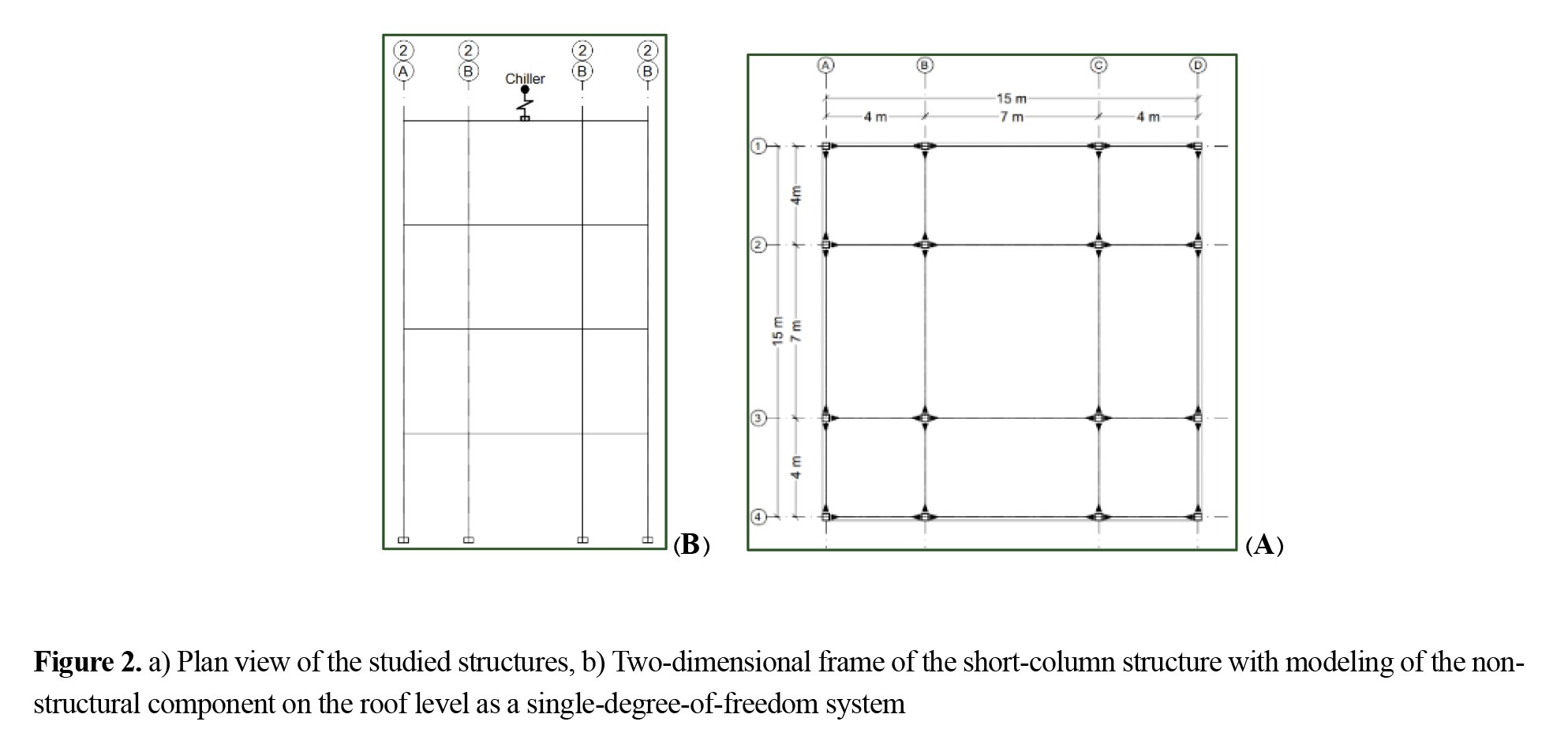
The lateral force-resisting system is modeled as an Intermediate Steel Moment Resisting Frame in both X and Y directions, integrated with a rigid diaphragm system. To ensure economic optimization of the structural design, columns are designed using box sections, while beams utilize IPE (wide-flange) profiles. The maximum inter-story drift ratios are found to be very close to the allowable limits specified in the Iranian Standard 2800 (2013). Furthermore, the stress ratios of the structural members under critical load combinations are approximately unity.
The nonlinear behavior of beam and column elements was modeled using concentrated plasticity at the ends of the flexural members within SAP2000 (version 20). The hysteretic behavior of these elements was defined based on the formulations provided in the Iranian National Building Code, Publication 360 (2013). To validate the accuracy of the nonlinear software model, the seismic response of a two-dimensional frame was compared against the benchmark results reported by Thai and Kim (Thai and Kim; 2011) under the 1994 Northridge earthquake record.
“Subsequently, nonlinear time-history analyses (NLTHA) were performed on the three-dimensional models of the target structures, considering both horizontal and vertical components. Eleven ground motion records, encompassing both near-field and far-field regions, were utilized. As detailed in
Table 1, these records were selected from the PEER NGA-West2 database based on the following seismic criteria: a moment magnitude (Mw) ranging from 6.0 to 8.0, and fault-to-site distances of less than 15 km for near-field records and greater than 30 km for far-field records.
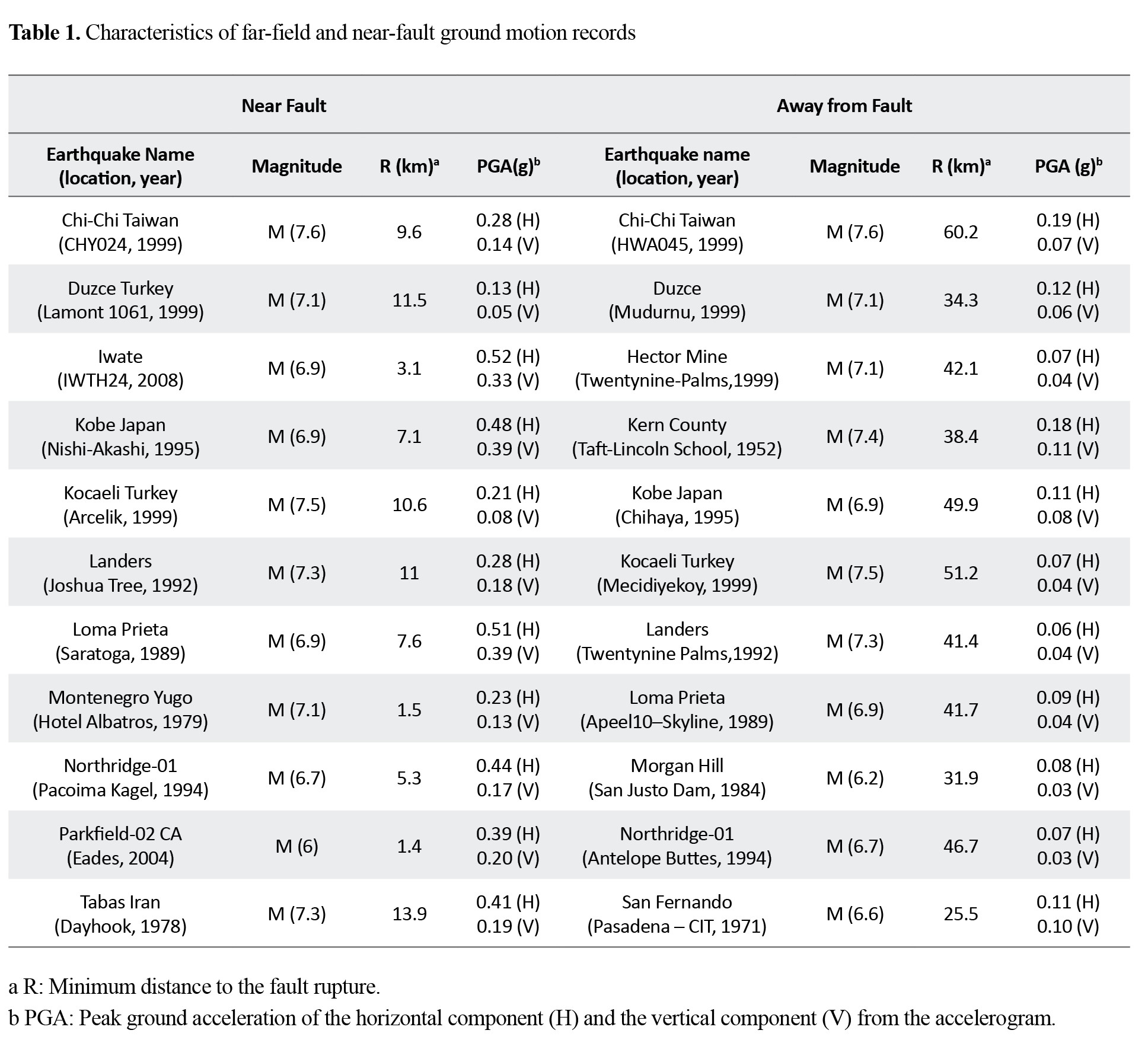
The selected near-field motions are characterized by significant velocity pulses due to forward directivity, with shear-wave velocities (Vs30) at the recording stations ranging from 375 to 750 m/s. Each set of ground motion records was scaled such that the seismic intensity at the structural base matches the target design spectrum for a 475-year return period, in accordance with the Iranian Standard 2800 (2013) for Site Class II. For instance,
Figure 3 illustrates the average SRSS (square root of the sum of the squares) response spectrum for the pairs of near-field horizontal ground motions after the application of the scaling factors.
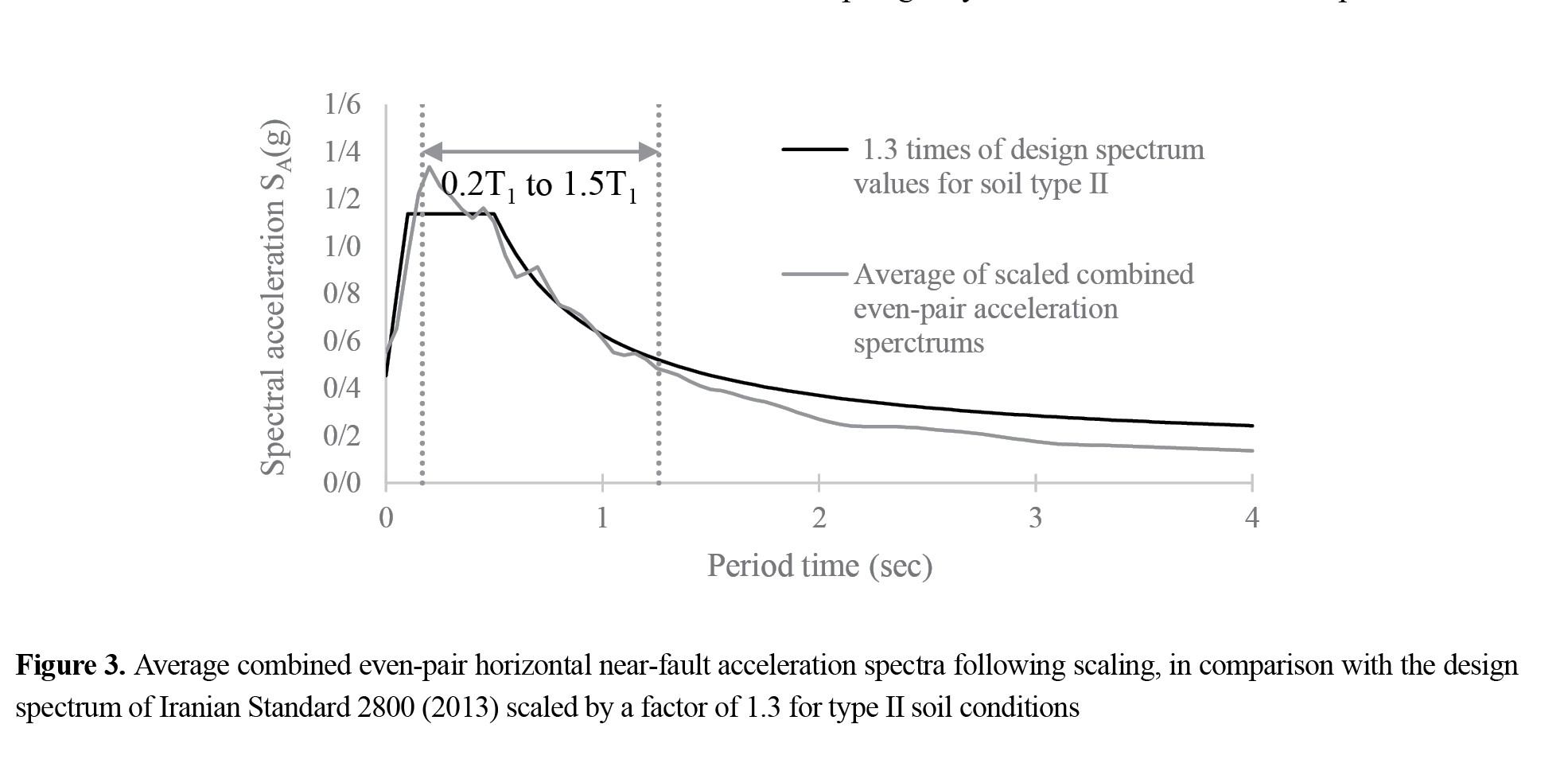
As illustrated in the figure, the spectral values within the period range of 0.2 s < T < 1.5 s (encompassing the fundamental period of the four-story structure) exhibit a deviation of less than 10% from 1.3 times the design spectrum of the 4th edition of Iranian Standard 2800 for Site Class II in a very high seismic hazard region. Furthermore, the scaling factors for the vertical components of each ground motion were determined in a manner consistent with the horizontal components, following the established procedures for vertical component scaling to the design spectrum as prescribed in ASCE 7-16 (2022).
To mitigate the uncertainties arising from the selection of specific ground motion records on the research outcomes, statistical analyses were performed. The mean and the Mean±SD of the responses were calculated for each group of ground motion records, and the subsequent discussion is based on these statistical parameters.
Non-structural components and analysis method
In this study, the scope of acceleration-sensitive non-structural components encompassed all elements attached to a structural floor or roof influenced by the acceleration transmitted through the respective diaphragm. To evaluate the force exerted on these non-structural components due to the application of seismic ground motion records to the structures, a linear single-degree-of-freedom (SDOF) model was employed, following the procedure illustrated in
Figure 4 .
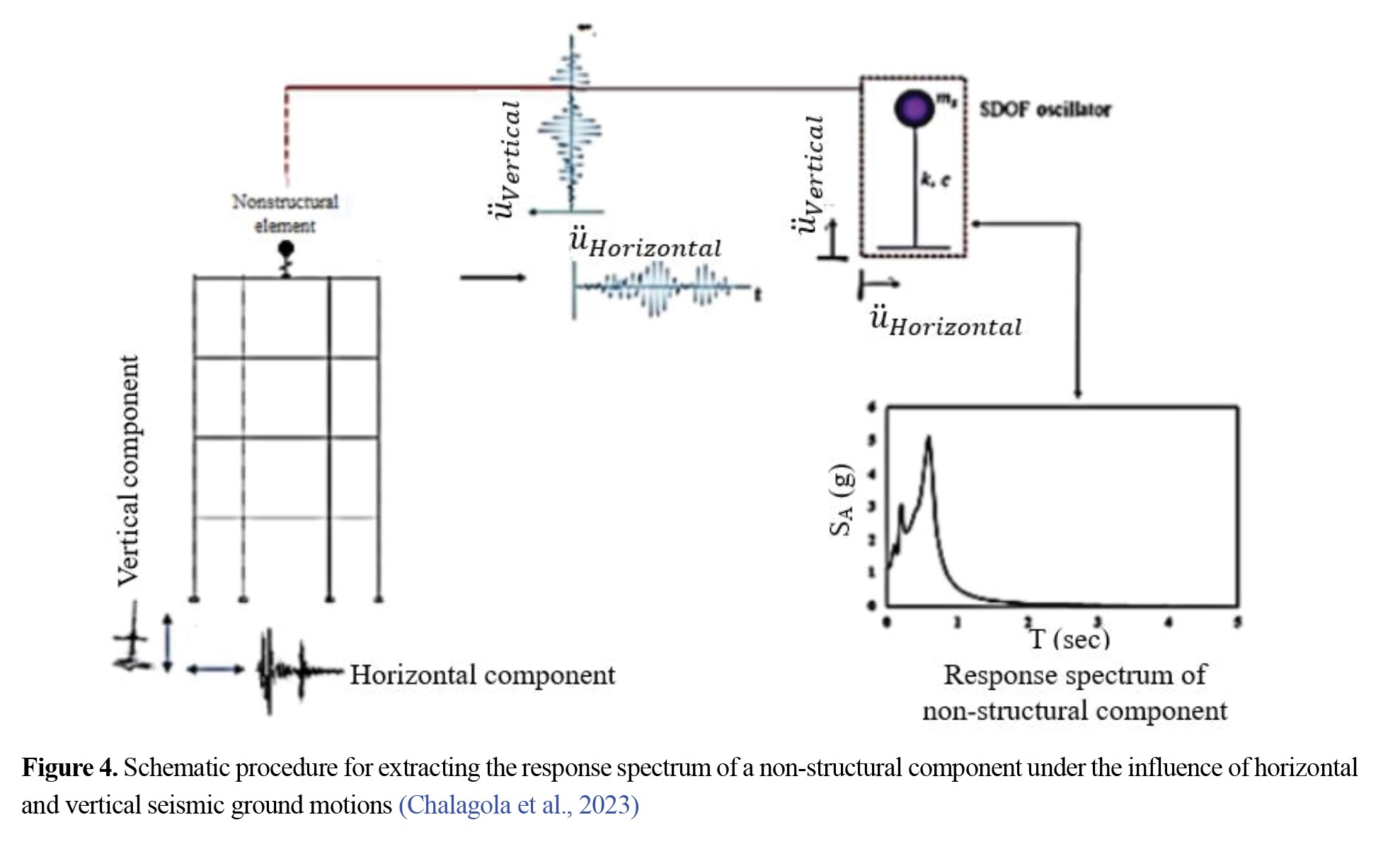
Following the procedure illustrated in
Figure 4, the horizontal and vertical acceleration time-histories at the floor or roof level—connected to the support of the non-structural component—were extracted from each seismic record applied to the structural support. Subsequently, the acceleration amplification factor at the center of mass of the acceleration-sensitive non-structural component, relative to the input acceleration at its support, was determined using SeismoSignal software (version 4.03). Finally, the maximum force exerted on the non-structural component for each ground motion record, denoted as Fp, was calculated in accordance with
Equation 1 of the Iranian Standard 2800 (2013). The mean force across all considered seismic records was then obtained
1. FP= IP.mp.ai.ap Rpu
In this equation, mp is the mass of the non-structural component, which for the comparative purposes of this study is considered equal to one kilogram, and the force exerted on a non-structural component with a unit weight is examined in the following sections. Also, ai is the maximum acceleration resulting from the application of each of the seismic records at the floor or ceiling level connected to the non-structural component, whose unit is considered in meters per second squared. ap is the acceleration magnification factor at the center of mass of the non-structural component according to its type and period. Ip and Rpu are the importance factor and behavior factor of the non-structural component, respectively, according to the Iranian Standard 2800 (2013). The specifications of specific types of acceleration-sensitive non-structural components, including false ceilings and cooling towers, which are used as case examples in the following sections, are listed below.
Results
Investigation of near-fault effects on the horizontal force applied to the center of mass of acceleration-sensitive non-structural components
In this section, the horizontal lateral force exerted on a suspended ceiling—a prevalent type of non-structural component in buildings—is investigated using various analytical methods under two distinct seismic scenarios: near-fault and far-field ground motions. Given that the prevention of collapse or damage to the suspended ceiling is essential to ensure the continuous serviceability of the building, an importance factor (Ip) of 4.1 and a response modification factor (Rpu) of 5.2 were adopted, in accordance with the Iranian Standard (2013).
To determine the acceleration amplification factor (ap) under the influence of the selected ground motion records, the procedure illustrated in
Figure 4 was adopted. The aforementioned factor was derived from the acceleration response spectrum of each floor level for each category of seismic records. The fundamental period of the suspended ceiling with gypsum boards was set to 0.8 s0.8 s, based on the experimental details reported by Özçelik et al. (Özçelik et al., 2016). Subsequently, the peak force acting on a unit mass (1 kg) of the suspended ceiling—equivalent to an area of 0.15 m2—was calculated using
Equation 1.
To calculate the acceleration magnification factor ap, under the effect of the desired records, the process shown in
Figure 4 was used and the aforementioned factor was obtained through the acceleration response spectrum of each floor under the effect of each seismic record of each category. The periodic time of the first mode of the false ceiling with gypsum boards was extracted as 0.08 seconds based on the implementation details of the laboratory study by Özçelik et al. (2016). Then, the maximum force applied to a part of the false ceiling with a mass of one kilogram, equivalent to the mass of an area equal to 0.15 m2 of the desired false ceiling, was calculated through
Equation 1.
The average peak horizontal forces exerted on the suspended ceiling, resulting from the application of far-field and near-fault ground motion suites, are presented in
Figure 5 for cases where the components are attached to the structural floor levels from the first to the top story.
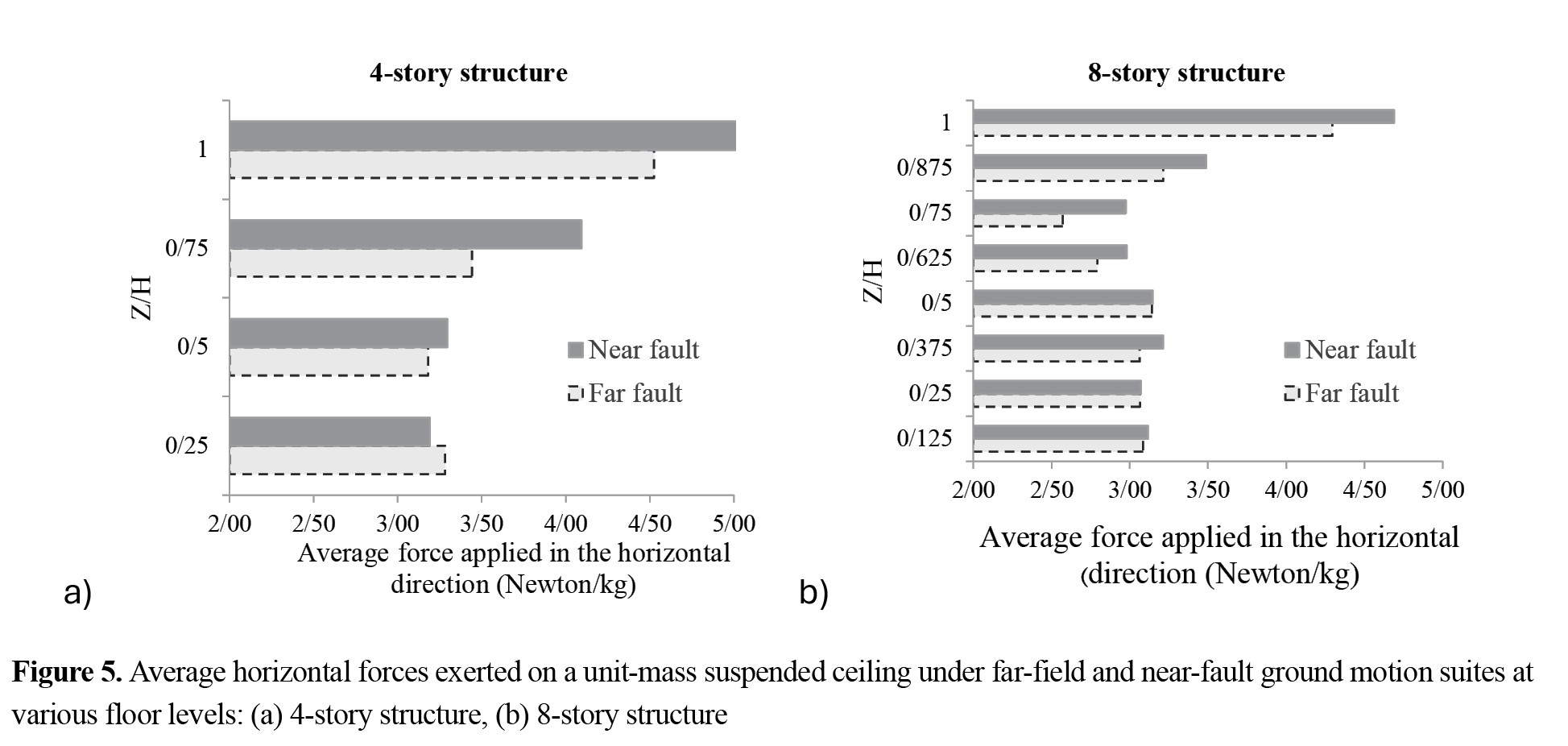
In this figure, H denotes the total building height, and Z represents the elevation of the non-structural component’s location. As illustrated in the plots of
Figure 5, the influence of near-fault effects on the amplification of horizontal forces applied to the non-structural components was significantly more pronounced in the upper half of the buildings compared to the lower half. The maximum increments were observed in the third story of the four-story building (19%) and in the sixth story of the eight-story building (16%)
It should be noted that the analytical formulas provided in the fourth edition of the Iranian Standard (2013) for estimating horizontal forces on non-structural components employ an equivalent static analysis method, which assumes a linear distribution profile increasing with height based on the Z/H ratio. An examination of the plots in
Figure 5, which were derived via the nonlinear time-history analysis (NTHA) method, revealed that for the low-rise structure (4 stories), the distribution of horizontal forces closely followed the linear trend prescribed by the Iranian Standard. However, in the mid-rise structure (8 stories), a distinct discrepancy was observed: the horizontal force remained nearly constant from the first to the sixth stories, followed by a sharp increase in the upper stories under both far-field and near-fault ground motion suites. This behavior deviated significantly from the linear distribution profile mandated by the code.
Table 2 presents the mean and the Mean±SD values of the horizontal inertial forces acting on the suspended ceiling of the 4-story structure under various near-fault ground motion suites.
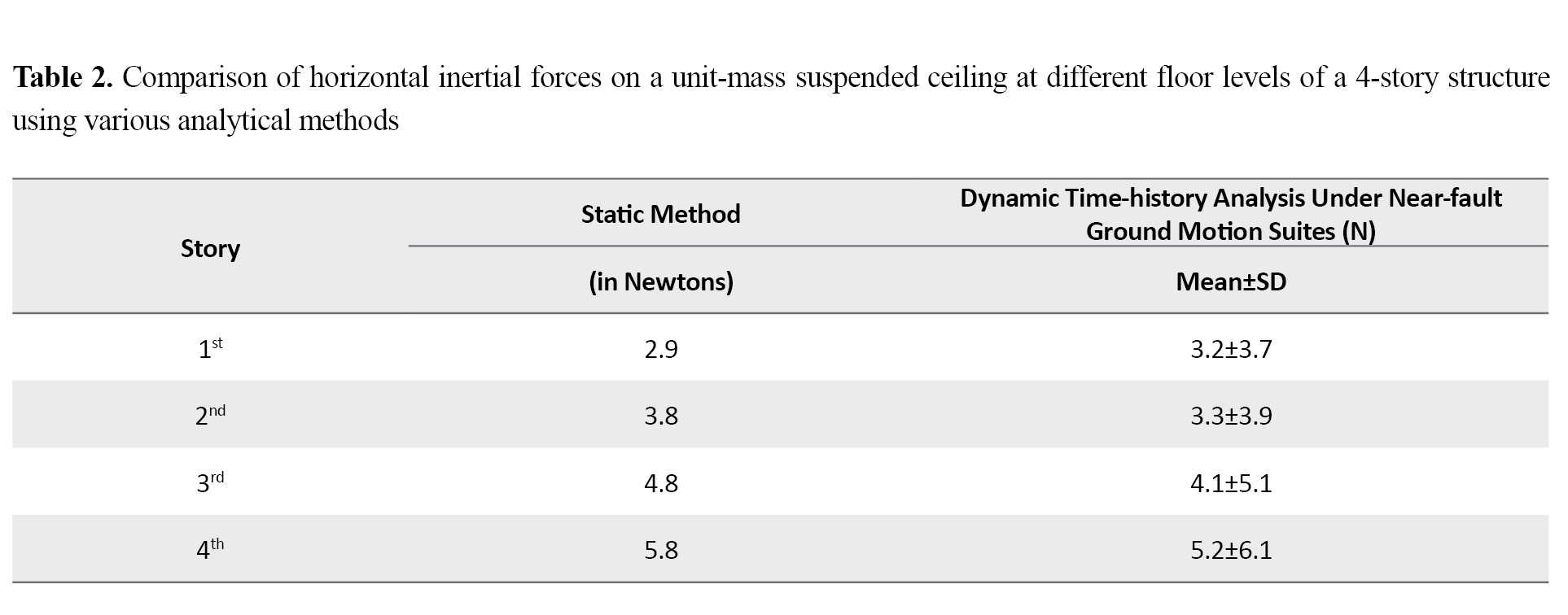
The second column of this table provides the inertial force calculated using the simplified linear static method as prescribed by the Iranian Standard (2013) for comparative purposes. Since both analytical approaches are based on the same design earthquake hazard level, this comparison facilitates an assessment of the conservatism of the simplified code-based method relative to more realistic dynamic analysis approaches. As indicated in the table, the mean inertial force derived from the ground motion suites was lower than the value predicted by the simplified code-based equations. This suggests that, when considering mean values, the simplified code-based approach provides a conservative estimate compared to the more accurate dynamic analysis. However, when a more pessimistic scenario—defined by the mean-plus-standard-deviation—was employed, the code-based force for near-fault ground motions becoame non-conservative. Given this finding, it is imperative to account for these discrepancies in the seismic design of non-structural components for high- and extremely important structures located in near-fault regions to ensure uninterrupted serviceability.
Investigation of near-fault effects on the vertical forces acting on the center of mass of acceleration-sensitive non-structural components
To estimate the probability of overturning, uplift, and falling in acceleration-sensitive non-structural components, it is necessary to evaluate the vertical forces acting perpendicular to the floor or ceiling levels, in addition to the horizontal inertial forces, as illustrated in
Figure 1. This consideration becomes increasingly critical when the non-structural element is positioned in locations sensitive to vertical motion, such as the mid-span of long beams or on cantilevered beams.
In this section, the vertical forces exerted on the non-structural component at various floor levels are extracted under each ground motion record, assuming the component is located at the mid-span of a 7-m long beam (
Figure 2). The results are categorized into far-field and near-fault suites and averaged accordingly. To this end, the assumption of full component rigidity and purely elastic vertical behavior—corresponding to ap=1 and Rpu=1—was adopted, following the approach prescribed in seismic codes, such as Iranian Standard 2800 (2013). It should be noted that a more refined method for accounting for partial vertical flexibility in certain types of non-structural components is investigated in the subsequent section.
Figure 6 illustrates the mean vertical forces exerted on a unit-weight non-structural component at various floor levels under both far-field and near-fault seismic scenarios.
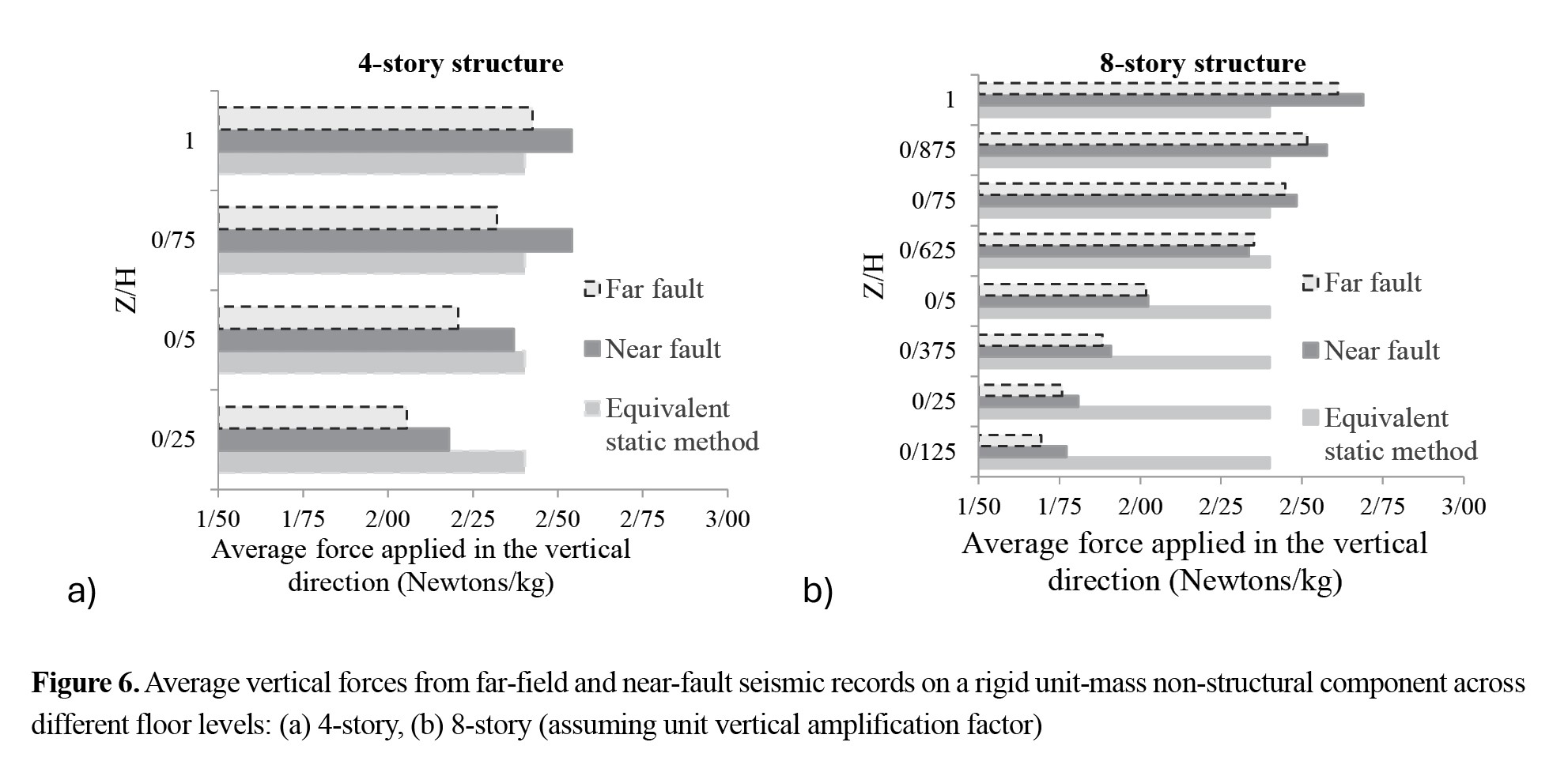
The impact of near-fault ground motions on the non-structural component is significantly more pronounced in the 4-story structure than in the 8-story structure. This can be attributed to the proximity between the fundamental vertical natural frequency of the low- rise structure and the dominant frequency content of the vertical seismic component. The maximum increase in vertical force was observed at the third floor of the 4-story structure, amounting to 10%.
Furthermore, the vertical forces acting on the non-structural components at various heights were calculated using the equivalent static method in accordance with Iranian Standard 2800 (2019), as illustrated in
Figure 6. The forces estimated via this method remained constant across all floor levels and were independent of the component’s vertical position. A comparison between the dynamic time-history distribution and the simplified static distribution (
Figure 6) revealed that the vertical force distribution in the 4-story structure closely followed the constant distribution of the simplified static approach. However, in the upper stories of both the low-rise and mid-rise structures, the mean vertical forces obtained through nonlinear time-history analysis under near-fault seismic records exhibited higher values compared to those predicted by the proposed code-based simplified method.
Investigation of the influence of non-structural component period on the acceleration amplification factor at the center of mass
The magnitude of acceleration amplification (resonance) at the center of mass of non-structural components, relative to the input acceleration at its floor-based connection point, is fundamentally dependent on the component’s natural period and damping ratio. This section investigates the horizontal and vertical acceleration amplification factors for acceleration-sensitive non-structural components across a range of natural periods. Given that the natural periods of most non-structural components typically fall within the 0 to 0.5 s range, with damping ratios below 5% (Gerontati & Vamvatsikos, 2025), the variations in both horizontal and vertical acceleration amplification factors were examined within this specific interval.
To this end, the mean horizontal acceleration amplification factor spectra, generated for the non-structural components under all seismic records applied to the 4-story and 8-story structures, were extracted.
Figure 7a presents the aforementioned spectra assuming the non-structural component is located at every floor level of the 4-story structure.
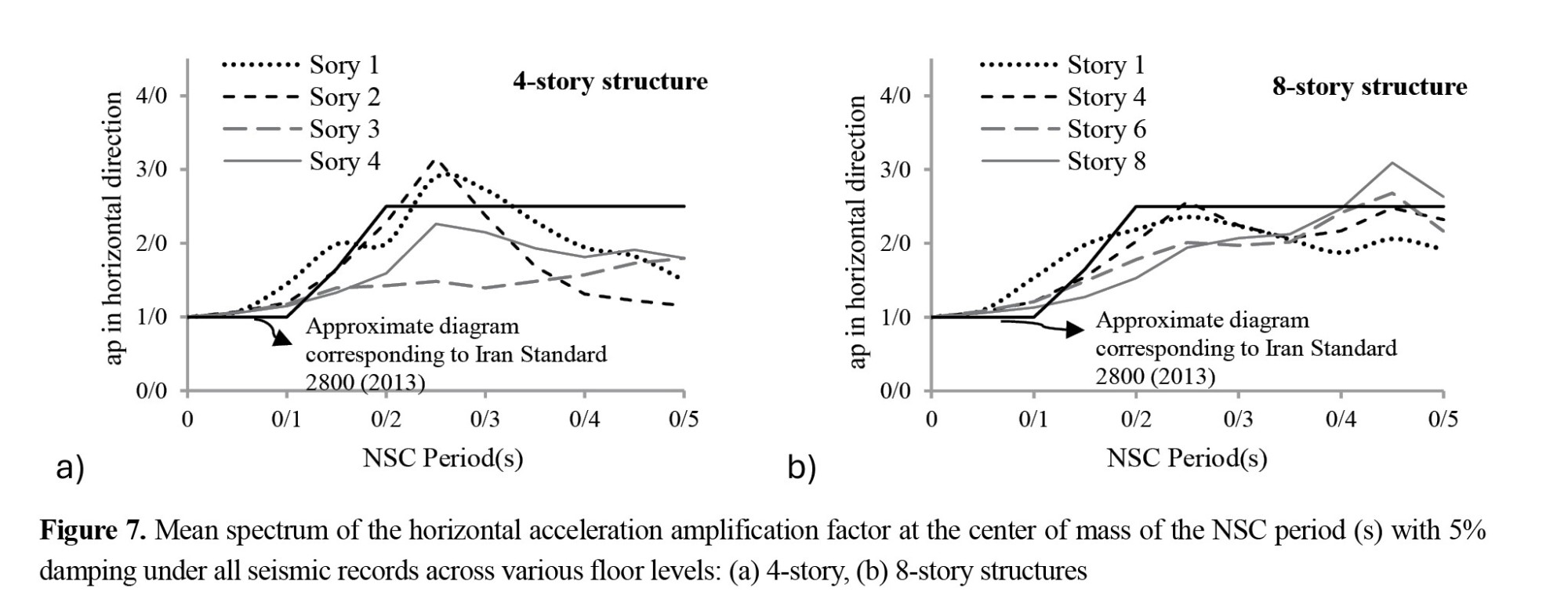
For the 8-story structure, the spectra are specifically shown for the first, fourth, sixth, and top floors in
Figure 7b. As illustrated in these plots, the placement of the non-structural component in the lower half of the structure has a more pronounced effect on increasing the horizontal acceleration amplification factor at the component’s center of mass
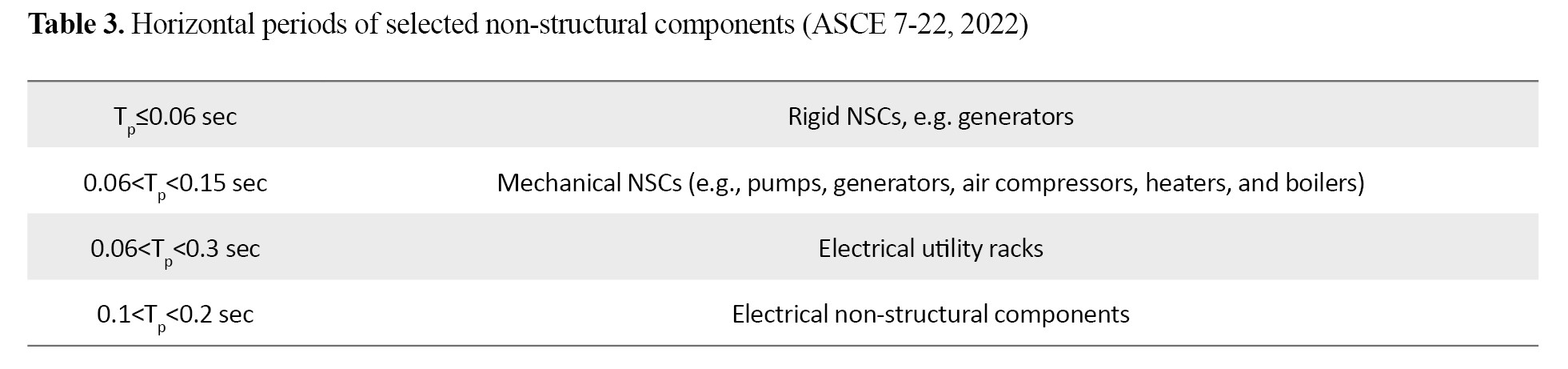
Since determining the natural periods of non-structural components requires extensive laboratory testing, most seismic codes, including Iran’s Standard 2800 (2013), provide the horizontal acceleration amplification factor (ap) based on component type instead of period. For this reason, an exact code-based curve for ap versus period is unavailable, and
Figure 6 presents an approximate plot. This approximation was extracted from experimental research on non-structural component periods, following the data presented in
Table 3 of the ASCE 7-22 Commentary (2022).
The plot shows that for non-rigid components with periods greater than 1.0 s, locating them in the lower levels leads to mean horizontal amplification factors that are higher than the code-recommended values.
Furthermore, in the 8-story structure, locating non-structural components with periods exceeding 4.0 s at the roof level resulted in horizontal acceleration amplification factors that surpassed the values prescribed by seismic codes. This may lead to a non-conservative estimation of inertial forces when using the equivalent static method for flexible, soft-behavior non-structural components at the roof level of mid-rise structures, under both far-field and near-fault ground motion regimes. Notably, reducing the non-structural component damping ratio from 5% to 2% yielded a 40% increase in the amplification factor across all natural periods. This significant escalation led to a substantial increase in the inertial forces acting on low-damping, acceleration-sensitive components.
Subsequently, the vertical acceleration amplification factor at the center of mass of non-structural components with vertical periods shorter than 0.5 s—placed on long-span floors across various levels of the 4- and 8-story structures—was investigated. As illustrated in
Figure 8, the floor level had a negligible effect on the vertical acceleration amplification factor.
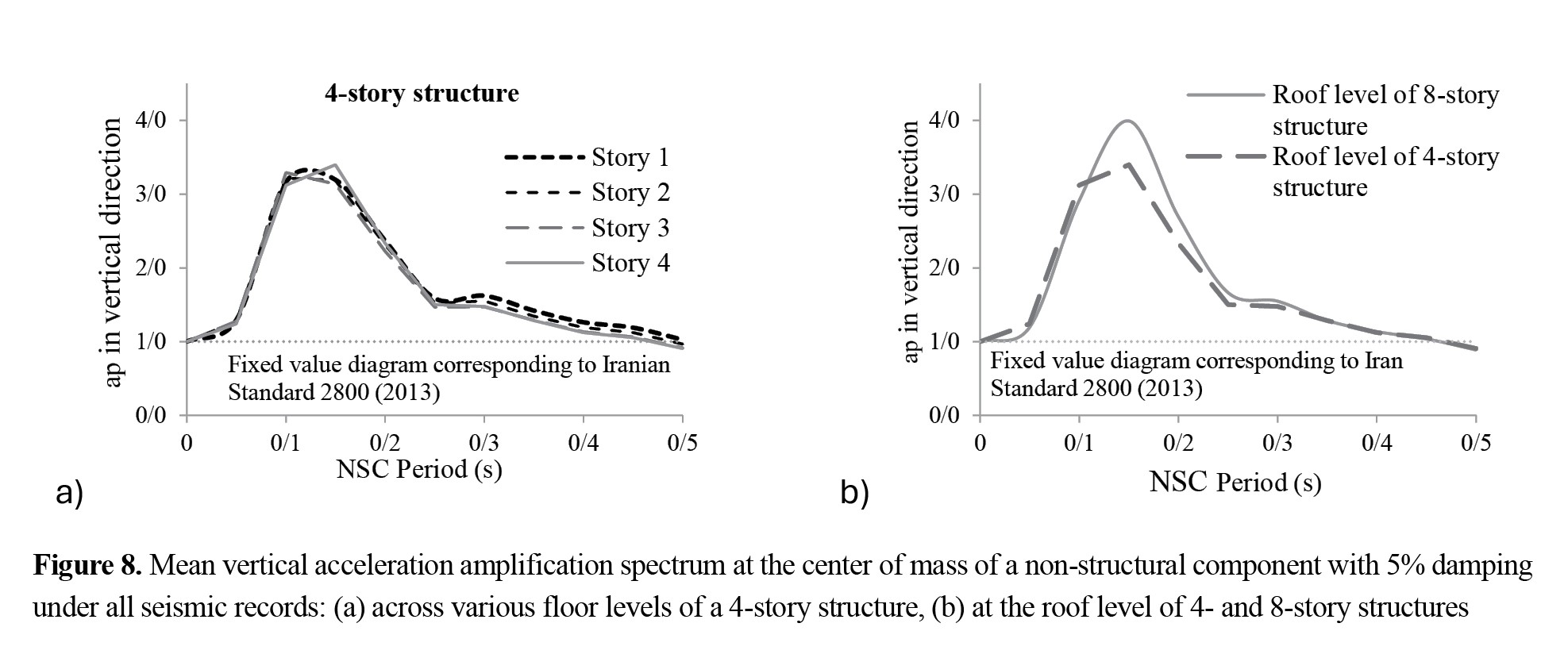
According to most seismic codes, such as the Iranian Standard 2800 (2013), the vertical amplification factor is assumed to be unity for all non-structural components, regardless of their type or natural period, which is represented by a constant line in
Figure 8. However, for flexible non-structural components with vertical periods between 0.05 s and 0.35 s, the mean vertical amplification factor can reach up to 3 and 4 times the code-recommended values for the 4- and 8-story structures, respectively. This substantial discrepancy suggests that the equivalent static analysis method may lead to non-conservative seismic designs for these components.
For instance, the natural vertical period of a cooling tower was considered as 0.21 s when empty and 0.22 s when full, based on the experimental study by Strozzi et al. (2015). Its damping ratio was taken as 4%, and its weight when full was 27.9 kN. Assuming this cooling tower is installed on the roof of the studied structures, which are designated for high-importance usage, the vertical inertial force acting on the full cooling tower was calculated using time-history analysis. To this end, the vertical acceleration amplification factor corresponding to the full cooling tower’s natural period, as depicted in
Figure 8, was employed. The mean vertical inertial force on the cooling tower installed on the roof of the 4-story and 8-story structures were found to be 13 kN and 15.3 kN, respectively, within the near-fault scenario. This is in contrast to the code-based equivalent static analysis method, which estimates this force as 6.8 kN for both structural configurations, predicated on the assumption of the non-structural component’s complete vertical rigidity. Consequently, the non-conservative estimation of the vertical force for the aforementioned cooling tower using the conventional code-based method is evident.
The enhanced implementation and dissemination of the supplementary provisions of the draft of the fifth edition of Iran’s Standard 2800 (2024) —specifically, the inclusion of nonlinear time-history analysis as a method for assessing non-structural components, and the clarification on selecting and applying seismic ground motions at near-fault sites—can significantly mitigate the seismic risk of critical facilities, such as hospitals and emergency response centers, against potential future earthquakes and their subsequent aftershocks.
Discussion
This research investigated the factors influencing seismic inertial forces on acceleration-sensitive non-structural components located at the floor or attached to the ceiling of steel moment-resisting frame buildings with moderate ductility. The seismic performance of two example structures—a low-rise (4-story) and a mid-rise (8-story) building—was analyzed using nonlinear time-history analysis. The structures were subjected to a simultaneous application of horizontal and vertical components of two sets of ground motion records: near-fault and far-fault (11 records in each set). Subsequently, the forces acting on acceleration-sensitive non-structural components with periods less than 0.5 s were extracted using two methods: direct application of ground motion records and the simplified equivalent static analysis method, considering the design-level earthquake hazard. The results obtained are summarized as follows:
The amplification effects associated with near-fault ground motions on the horizontal inertial forces acting on non-structural components were observed to be more pronounced when the components were located in the upper half of the building height compared with those positioned in the lower half of the studied structures. The maximum increase, amounting to 19%, occurred at the third floor of the 4-story structure, where the estimated force under near-fault earthquakes exceeded that obtained under far-fault conditions.
Analysis of the vertical distribution of horizontal forces acting on non-structural components along the height of the studied buildings, based on nonlinear time-history analysis, indicated that the force distribution pattern in the low-rise structure (4 stories) is generally consistent with the linear distribution proposed in the equivalent static analysis procedure of the Iranian Standard 2800 (2013). However, in the mid-rise structure (8 stories), an approximately uniform force distribution from the first to the sixth floors, followed by a sharp increase in the upper stories, was observed under both near-fault and far-fault ground motion records. This trend deviates from the current code-prescribed linear distribution.
The floor level at which a non-structural component is located has a significant impact on its horizontal acceleration amplification factor, particularly for components exhibiting flexible behavior with natural periods exceeding 1.0 s. Consequently, the conventional approach adopted by many engineering firms—which involves providing uniform connection details for acceleration-sensitive non-structural components regardless of their floor level—may lead to critical failure modes, such as rocking, sliding, overturning, or complete detachment of the components.
Analysis of the vertical inertial forces using dynamic analysis indicated that the effects of near-fault ground motions on non-structural components installed at all floor levels are more pronounced in the 4-story structure than in the 8-story structure. This may be attributed to the proximity of the vertical natural frequency of the low-rise structure to the dominant frequency content of the vertical seismic component. Furthermore, in the upper half of both the low-rise and mid-rise structures, the mean vertical force obtained via nonlinear time-history analysis under near-fault records was higher than the values predicted by the simplified equivalent static analysis method.
Conclusion
Analysis of the vertical acceleration amplification factor at the center of mass of the non-structural components demonstrated the necessity of considering the vertical natural periods of these components. For flexible non-structural components with vertical periods ranging from 0.05 s to 0.35 s, the mean amplification factor increased by factors of 3 and 4, respectively, compared to the code-prescribed values for the 4-story and 8-story structures. This discrepancy indicates that the current seismic design for the vertical direction of such components, when utilizing the simplified equivalent static analysis method, may be non-conservative.
Limitations
This study is limited to the seismic behavior of acceleration-sensitive non-structural components within regular plan and height structures featuring steel moment-resisting frames, specifically low-rise (4-story) and mid-rise (8-story) configurations. The analysis was conducted on firm soil sites (type II) without the presence of near-fault effects (fault rupture) directly beneath the structure. To generalize these findings, future research should investigate a broader spectrum of structural systems across various soil conditions, utilizing a wider range of ground motion records with diverse frequency contents and different seismic hazard levels.
Ethical Considerations
Compliance with ethical guidelines
All ethical principles were considered throughout this study, and informed consent was obtained from all participants prior to their participation. Since no experiments were conducted on animal or human samples, no ethical code was required.
Funding
This article was extracted from a master's thesis in Civil Engineering (Earthquake) at the Department of Civil Engineering, West Tehran Branch, Islamic Azad University , Tehran, Iran. This research did not receive any specific grant from funding agencies in the public, commercial, or not-for-profit sectors.
Conflicts of interest
The authors declared no conflict of interest.
References
Aghaei-Araei, A., Ghodrati-Ghazaani, A., Attarchian, N., Salamat, A. S. & Hasani, H. (2019). [Design spectra for near fault ground motions considering frequency-dependence of material behavior (Persian)]. Tehran: Building and Housing Research Center (BHRC), Iran. [Link]
Ahmad, Z., Ahmed, H. A., Shahzada, K., & Li, Y. (2024). Vulnerability of non-structural elements (NSEs) in buildings and their life cycle assessment: A review. Buildings, 14(1), 170. [DOI:10.3390/buildings14010170]
ASCE standard. (2022). Minimum design loads and associated criteria for buildings and other structures. Virginia: American Society of Civil Engineers. [DOI:10.1061/9780784415788]
Astroza, R., Pantoli, E., Selva, F., Restrepo, J. I., Hutchinson, T. C., & Conte, J. P. (2015). Experimental evaluation of the seismic response of a rooftop-mounted cooling tower. Earthquake Spectra, 31(3), 1567-1589. [DOI:10.1193/071513EQS205M]
Challagulla, S. P., Kontoni, D. P. N., Suluguru, A. K., Hossain, I., Ramakrishna, U., & Jameel, M. (2023). Assessing the seismic demands on non-structural components attached to reinforced concrete frames. Applied Sciences, 13(3), 1817. [DOI:10.3390/app13031817]
Filiatrault, A., Perrone, D., Merino, R. J., & Calvi, G. M. (2021). Performance-based seismic design of nonstructural building elements. Journal of Earthquake Engineering, 25(2), 237-269. [DOI:10.1080/13632469.2018.1512910]
Gerontati, A., & Vamvatsikos, D. (2025). Intensity measures for short‐period structures and their non‐structural components. Earthquake Engineering & Structural Dynamics, 54(5), 1361-1375. [DOI:10.1002/eqe.4314]
Gremer, N., Adam, C., Medina, R. A., & Moschen, L. (2019). Vertical peak floor accelerations of elastic moment-resisting steel frames. Bulletin of Earthquake Engineering, 17, 3233-3254. [DOI:10.1007/s10518-019-00576-6]
Gümüş, M., & Durucan, C. (2022). Effects of pulse-like ground motion records with and without acceleration pulses on he earthquake responses of structures with varying dynamic properties. Structures, 45, 427-436. [DOI:10.1016/j.istruc.2022.09.042]
Hounser, G. W., & Hudson D. E. (1958). The Port Hueneme Earthquake of march 18, 1957. Bulletin of the Seismological Society of America, 48, 163-168. [DOI:10.1785/BSSA0480020163]
Iranian Management and Planning Organization. (2014). [Instructions for seismic rehabilitation of existing buildings (Persian)].Tehran: Publications of The Executive Technical System, Iran. [Link]
Building and Housing Research Center. (2015). [Iranian code of practice for seismic resistant design of buildings, Standard No. 2800 (Persian)]. Tehran: Building and Housing Research Center (BHRC), Iran. [Link]
Iranian Seismic Code. (2025). [Iranian code of practice for seismic resistant design of buildings, Standard No. 2800, Ed. 5 (Draft for public comment) (Persian)]. Tehran: Building and Housing Research Center (BHRC), Iran. [Link]
Kheildar, F. & Samouei, P. (2022). [Low-risk camps and medical service centers locating before an earthquake using the COCOSO MCDM method, case study: Rudbar, Gilan. (Persian)]. Disaster Prevention and Management Knowledge, 12 (3), 289-299. [Link]
Li, S., & Xie, L. L. (2007). Progress and trend on near-field problems in civil engineering. Acta Seismologica Sinica, 20(1), 105-114. [DOI:10.1007/s11589-007-0105-0]
Lim, E., Jiang, L., & Chouw, N. (2017). Dynamic response of a non-structural component with three supports in multi-directional earthquakes. Engineering Structures, 150, 143-152. [DOI:10.1016/j.engstruct.2017.07.028]
Mirmoghtadaee, M., Siadati, F., Eslamlou, M. S., Majid Zamani, S. S., Nayeri, A., & Sadeghi, Z., et al. (2024). [Urban Planning Regulations for Fault Avoidance Zone (Persian)]. Tehran: Building and Housing Research Center (BHRC), Iran. [Link]
O’Reilly, G. J., Hasegawa, K., Shahnazaryan, D., Poveda, J., Fukutomi, Y., & Kusaka, A., et al. (2024). On the fragility of non‐structural elements in loss and recovery: Field observations from Japan. Earthquake Engineering & Structural Dynamics, 53(3), 1125-1144. [DOI:10.1002/eqe.4066]
Ozcelik, O., Misir, I. S., & Saridogan, S. (2016). Performance evaluation of suspended ceiling systems using shake table test. Structural Engineering and Mechanics, 58(1), 121-142. [DOI:10.12989/sem.2016.58.1.121]
PEER Ground Motion Database. (2026). Pacific Earthquake Engineering Research Center. Berkeley: University of California. [Link]
Pirizadeh, M., Karoubi, A., & Lashgari-gehraz, S. M. (2024). On the vertical seismic response of the floor mounted motorized non-structural components. Journal of Seismology and Earthquake Engineering, 26(1), 61-70. [DOI:10.48303/jsee.2024.2031211.1098]
Shahbazi, S., Mansouri, I., Hu, J. W., Sam Daliri, N., & Karami, A. (2019). Seismic response of steel smfs subjected to vertical components of far‐and near‐field earthquakes with forward directivity effects. Advances in Civil Engineering, 2019(1), 2647387. [DOI:10.1155/2019/2647387]
Thai, H. T., & Kim, S. E. (2011). Practical advanced analysis software for nonlinear inelastic dynamic analysis of steel structures. Journal of Constructional Steel Research, 67(3), 453-461. [DOI:10.1016/j.jcsr.2010.09.009]
Zhai, C. H., Zheng, Z., Li, S., Pan, X., & Xie, L. L. (2016). Seismic response of nonstructural components considering the near-fault pulse-like ground motions. Earthquakes and Structures, 10(5), 1213-1232. [DOI:10.12989/eas.2016.10.5.1213]